


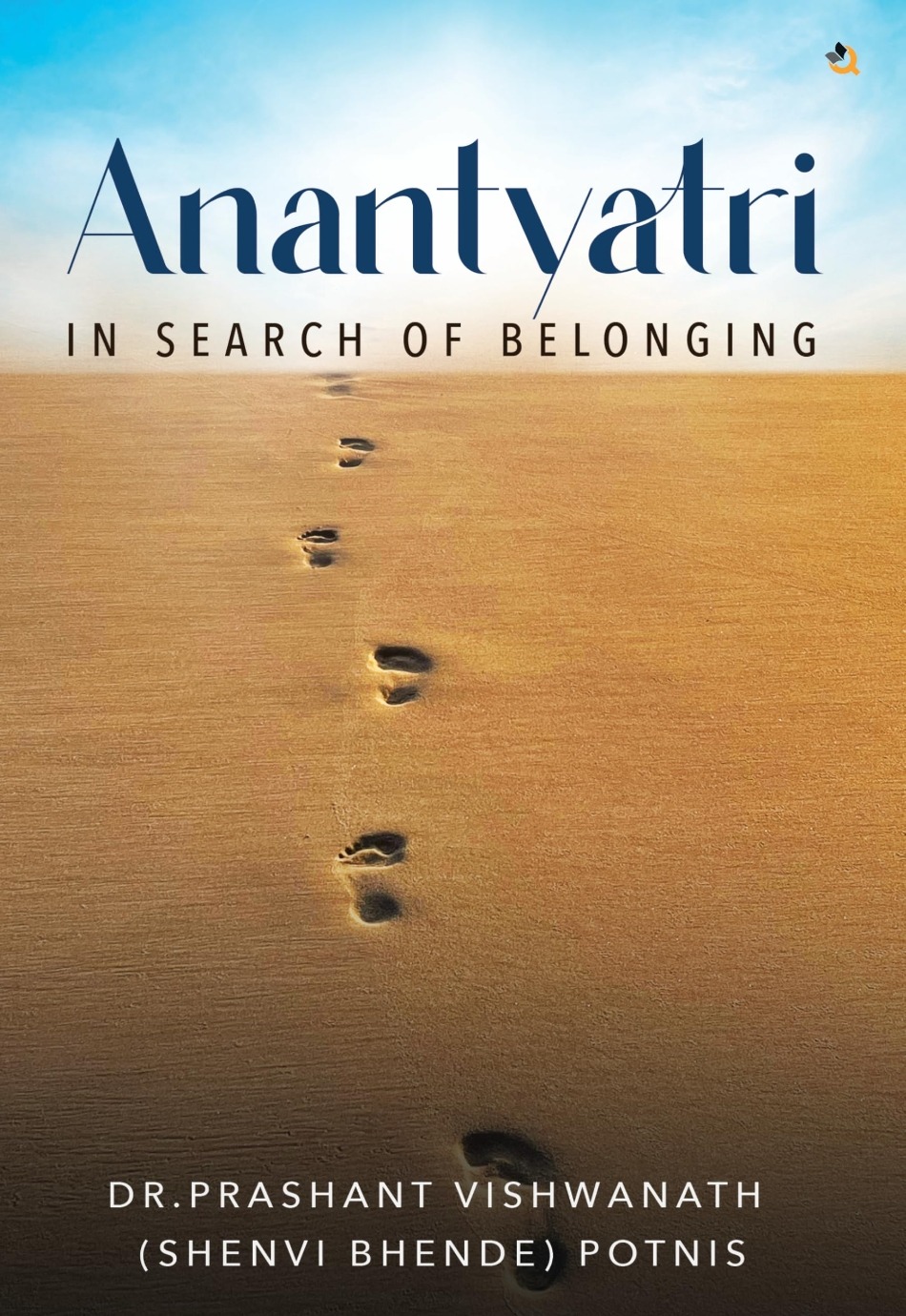
Q1. What inspired you to write Anantyatri: In Search of Belonging?
Dr. Potnis: Like many people in the middle phase of life, I began questioning where my family roots are from and what shaped my identity?. However, while writing the book there was realization that it is not merely my personal journey but linked to the history of an entire community also reflected in the journey of my family. It is about belonging, migration, culture, and history.
Q2. Why is tracing one’s roots important?
Understanding our roots gives us a stronger sense of identity while knowing some of the traits one currently carrying how they were inbibed from generation to generation. While history books often focus on kingdoms and empires, the stories of individual families are equally significant and interesting to learn. They explain how communities evolved, how traditions survived, and circumstances in people migrated while adapting new cultures. Family history also helps coming generations to appreciate their cultural heritage.
Q3. How does your family’s journey reflect the larger story of the Saraswat community?
My family’s documented journey begins in Quelossim (Goa) before moving to Quepem during periods of Portuguese inquisition. From there, they migrated to Sawantwadi, then Malvan, and eventually to Bombay (Mumbai).
However, the family’s historical narrative extends much further back through available historical theories, tracing possible origins from Central Asia, the Saraswati river region, Magadha, Mithila, and finally Goa. While some of these are based on traditional migration theories, they reflect the broader historical discussions surrounding Saraswat origins.
Q4. Your book discusses different theories about Aryan and Saraswat origins. Why did you include them?
Because understanding migration requires examining different scholarly viewpoints. Over time, several theories have been proposed regarding the origins of Aryans and saraswats.
Modern archaeology, genetics, linguistics, and historical research continue to refine these theories. My intention was not to declare one theory as absolute truth but to present the historical context through which scholars have attempted to understand these migrations.
Q5. How important was Goa in shaping Saraswat history?
Goa became one of the most important centres for the Saraswat community. Over centuries, Saraswats served as administrators, scholars, interpreters, merchants, diplomats, accountants, and advisors under different rulers including the Kadambas, Adil shahi,Portuguese and Marathas.
Their multilingual abilities and administrative skills allowed them to become cultural bridges between different kingdoms and political powers.
Q6. Your book also discusses kingdoms beyond Goa. Why?
No community develops in isolation.
The history of Goa is deeply connected with neighbouring kingdoms such as:
- Sonda Kingdom
- Sawant Bhosle Kingdom
- Adil Shahi Sultanate
- Maratha Empire
Understanding these kingdoms helps explain why migrations occurred and how political changes influenced families like mine.
Q7. The book contains an extensive family tree. Why was documenting genealogy important?
Family trees preserve memories that would otherwise disappear within two or three generations.
By documenting names, relationships, and migration patterns, future generations can understand where they came from. Genealogy also connects personal identity with broader historical developments.
Q8. One interesting discussion concerns the surname “Bhende.” What did you discover?
One suggests that the past family became known as Bhende because they were tax farmers who also cultivated bhendi (okra) in Goa
Other interpretation is farming along khazans-complex,community-engineered coastal wetlands protected by protective dykes and slice gates. The specific agricultural clans who mastered the intrinsic tilling techniques required to grow vegetables in these saline- heavy soils were given vegetable- rooted titles.This distinguishes their family’s agricultural expertise from those who focused strictly on paddy rice or coconut groves.
Rather than claiming certainty, I present these possibilities for readers to evaluate.
Q9. Why did you include traditional Saraswat recipes in the second half of the book?
Food is an equally important part of cultural identity.
Recipes preserve traditions just as much as historical records.
Many dishes documented in the book came from family members like Rukmabai Shenvi Bhende and Gopikabai Mangesh Potnis, representing generations of culinary heritage.
The recipes include:
- Sungta Hooman
- Kismoor
- Mangane
- Mooga Ghati
- Khatkhate
- Mango Sasav
- Sandgyanchi Aamti
- Kakadiche Dhondas
- Pamplet Kalputi
Together they represent the everyday cultural life of the Saraswat community.
Q10. Was writing this book more historical research or personal exploration?
It was both.
Historical documents provide facts.
Family memories provide emotions.
Together they create a much richer understanding of identity.
Q11. How does your book differ from other books on Saraswat history?
Several important books already exist on Saraswat history, including works by Chandrakant Keni, A.Gopalkrishna baliga and Chadranath VS Dhume.
Their work documents the history of entire communities.
My contribution is different because it begins with one family’s journey and uses it to understand the larger historical narrative.
It is history viewed through the lens of personal experience.
Q12. Who should read Anantyatri?
Anyone interested in:
- Family history
- Genealogy
- Migration studies
- Goa’s cultural heritage
- Saraswat history
- Indian social history
- Identity and belonging
Even readers with no connection to Goa may find similarities with their own family’s migration stories.
Q13. What is the central message of the book?
Every family carries within it a history that stretches across centuries.
When we trace our roots, we do not merely discover where we came from—we discover who we are.
Anantyatri reminds us that migration, resilience, adaptation, and cultural continuity are universal human experiences. Behind every surname lies a story, behind every family a journey, and behind every journey a search for belonging.
