

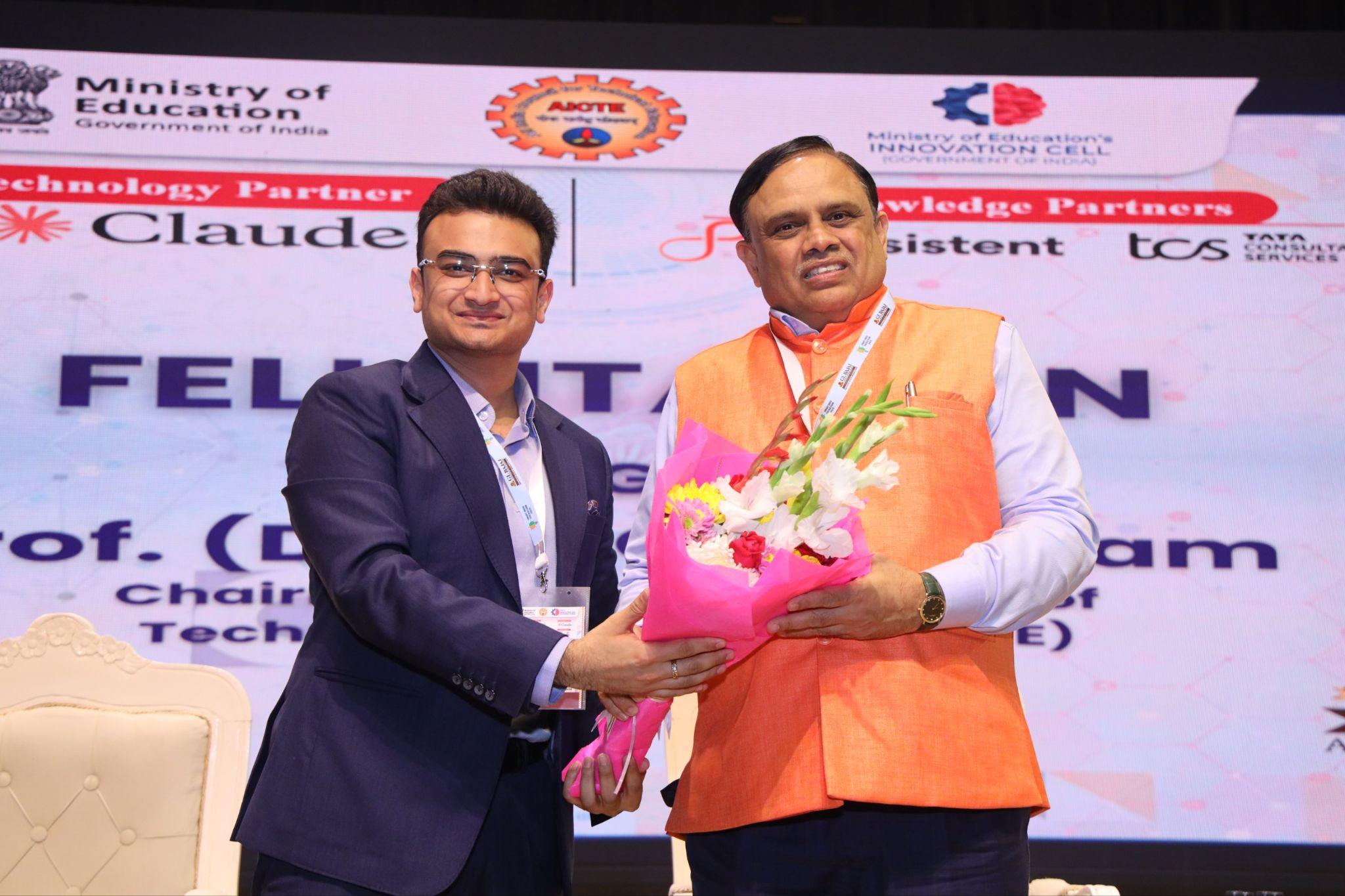
Walk through GL Bajaj Institute of Technology & Management on a hackathon weekend, and the difference is unmistakable. Classrooms turn into war rooms, whiteboards fill with circuit diagrams, and lectures give way to teams racing against a clock to turn an idea into a working prototype. What makes this notable is not any single event but the pattern behind it: over the past few years, GL Bajaj has established itself as one of the best institutions for technical education in the region, moving from merely sending delegations to national hackathons to actively hosting them, building a pipeline that connects student teams, faculty mentors, and government platforms into one continuous ecosystem of innovation.
A Nodal Centre for the Nation’s Largest Hackathon
That pipeline shows most clearly in the Smart India Hackathon (SIH), the Ministry of Education’s flagship innovation programme and, by most measures, the largest hackathon in the world. In December 2025, GLBITM was one of only 18 institutions selected nationwide as a Hardware Edition Nodal Centre for SIH’s eighth edition. Twenty-six finalist teams, from nine states and comprising 178 participants, spent 72 continuous hours on the Greater Noida campus building hardware solutions against five problem statements from the Ministry of Social Justice & Empowerment, covering assistive technology for the visually impaired, differently-abled individuals, amputees, and the deaf-mute community. The valedictory ceremony brought AICTE Chairman Prof. (Dr.) T. G. Sitharam and Dr. Dayanand, Programme Director at iDEX-DIO under the Ministry of Defence, to felicitate winning teams, and GL Bajaj sponsored the cash prizes, with each of the five winning teams receiving ₹1.5 lakh for solutions ranging from a smart blind stick to an IoT-enabled auxiliary crutch and a real-time orthotic pressure measurement device.
Hosting SIH is only half the story; GL Bajaj’s students have been winning at it for years. Back in 2020, Team CodeMagicians Aryan Maurya, Manik Goel and Rishabh Garg, mentored by Assistant Professors Virendra Pal Singh and Pankaj Sharma, took first prize in the Ministry of Women and Child Development category with “Naari,” a project addressing women’s safety, setting a precedent the institute has built on steadily since.
Kavach: Cybersecurity Under Pressure
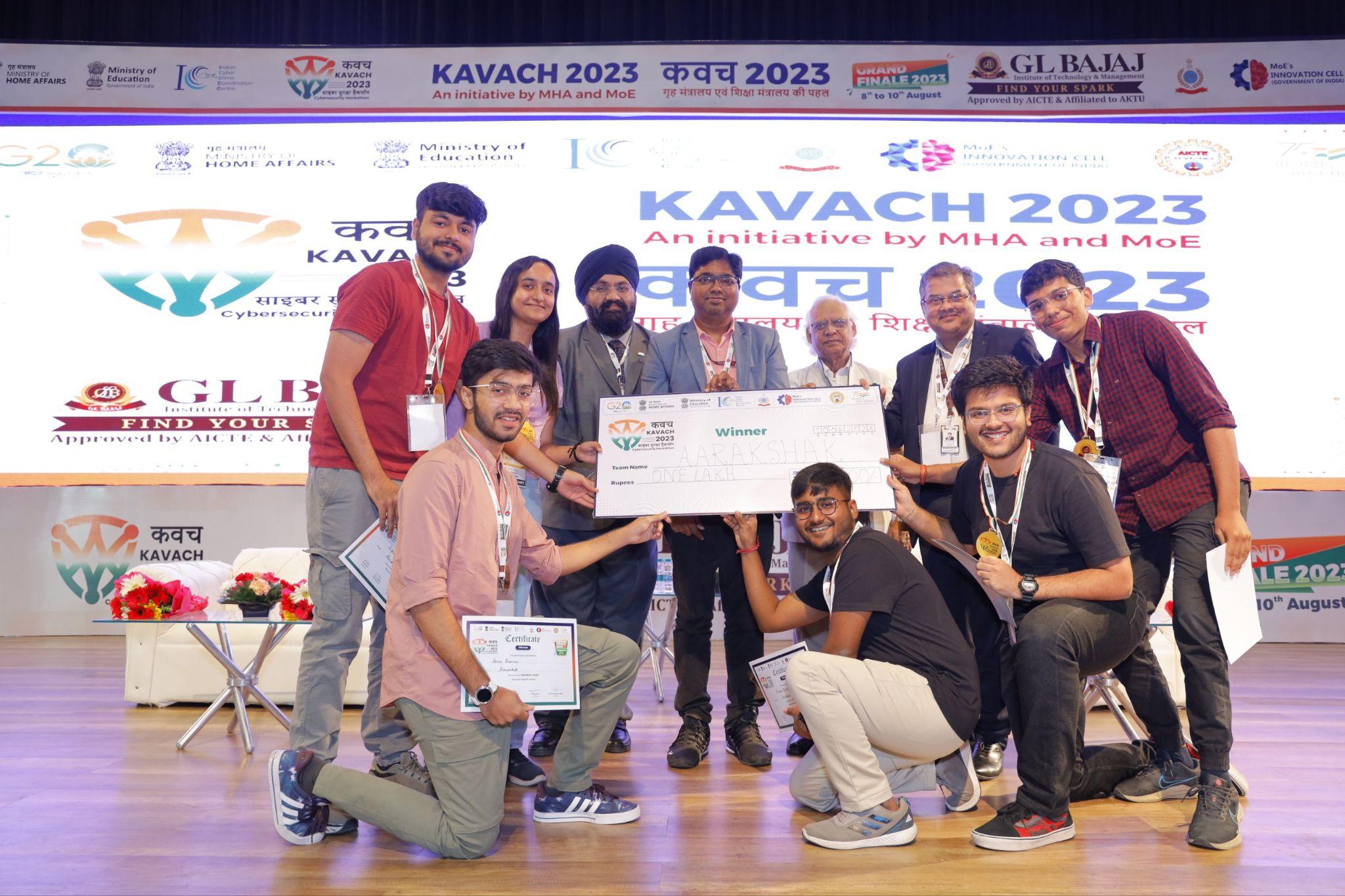
Where SIH tests breadth, Kavach narrows the focus to one of the most consequential domains in technology today: cybersecurity. Jointly run by the Ministry of Education’s Innovation Cell, AICTE, the Bureau of Police Research and Development, and the Indian Cyber Crime Coordination Centre, Kavach is a 36-hour non-stop hackathon built around challenges from data protection to digital fraud prevention. GL Bajaj was one of just five Nodal Centres nationwide for Kavach 2023, alongside Centurion University (Bhubaneswar), IES College of Technology (Bhopal), Pillai College of Engineering (New Panvel), and AMC Engineering College (Bengaluru) a footprint that drew over 500 students across 106 teams and distributed ₹20 lakh in prize money, with Shri Tapan Deka, IPS, Director of the Intelligence Bureau, presiding as chief guest. GL Bajaj’s own students delivered at the grand finale too: Team CodeSage Aman Kumar Singh, Aaditya Raj, and Aryan Raj (B.Tech CSAIML), Pragati Singh and Saurabh Sinha (B.Tech CSAI), and Yash Singhal (B.Tech CSE) won the “New Age Women Safety App” category at Panvel, Maharashtra, taking home ₹1 lakh. The same core team repeated that winning form the following year at Bhashini Sprint, a pattern that speaks to sustained mentorship on campus as much as individual talent.
Medha: Where Engineering Meets the Operating Table
The ecosystem’s most distinctive strand is Medha, a medical device hackathon run with the Biomedical Engineering and Technology Incubation Centre (BETiC) at IIT Bombay, which pulls engineering out of its own silo entirely. Medha 2025, held over 36 hours in October, drew more than 150 participants from mechanical and electronics engineering alongside physiotherapy, medicine, pharmacy, and the sciences. Practising doctors brought genuine clinical problems, and a jury from Sharda Hospital, Kailash Hospital, and government medical institutions evaluated the prototypes. Brigadier Rakesh Gupta, Director of the Government Institute of Medical Sciences, presided over the valedictory session, and the strongest teams advanced to a follow-up round at IIT Bombay itself. Vice Chairman Pankaj Agarwal described Medha as a reflection of the institute’s belief in innovation that serves humanity, engineering and medicine working side by side rather than in separate silos.
Beyond the Named Events
This same pipeline runs through smaller platforms too, extending rather than standing apart from the ecosystem. At Bhashini Sprint 1.0, run by India’s National Language Technology Mission and backed by the Ministry of Electronics and Information Technology, two GL Bajaj teams from the Department of Applied Computational Science and Engineering Team CodeSage (Aman Kumar Singh, Aaditya Raj, Pragati Singh, Aryan Raj) and Team The Boys 002 (Ansh Goyal, Pratham Arora, Nikunj Gupta, Harshit Khandwalia, Sahil Srivastav) won their respective problem statements and secured funding of ₹5 lakh each, with continued government support for the resulting startups. Institute-level contests carry the same energy forward: at a hackathon with the Tech-Visor Club, GL Bajaj Institute of Management crowned Team NeauroXoLabs champions, with Team Heisenberg and Team Quantum Hackers placing second and third in a prize pool exceeding ₹47,000, part of a GLB Hackathon series now in its fourth edition on the GLBIM campus and giving BBA and BCA students their own innovation platform alongside GLBITM’s engineering-focused contests. A regional drone technology contest hosted by the Mechanical Engineering department, won by a visiting team from SRMCEM Lucknow, is a reminder that GL Bajaj’s hosted events draw talent from well beyond its own student body.
Faculty Excellence Adds Another Dimension
The same ecosystem extends to faculty. Mr. Mohit Sharma, Training Coordinator & Cisco Networking Academy Instructor at GL Bajaj, secured the Overall Rank #1 Instructor position in the Cisco Networking Academy APJC Cyber & AI Learn-A-Thon 2026, one of the largest technology learning initiatives across the Asia Pacific, Japan, and China region, built to equip students with globally recognised skills in Artificial Intelligence, Cybersecurity, Networking, and Digital Technologies. Sharma planned and executed the Learn-A-Thon across campus, conducted awareness sessions on AI, cybersecurity, and networking, mentored students through courses, labs, assessments, and certifications, served as institutional point of contact with Cisco Networking Academy, tracked student progress, engagement, analytics, and campaign performance, and worked with faculty and students to maximise participation recognition reflecting the institute’s commitment to quality education, innovation, and industry-aligned skill development.
Why It Matters
Taken together, these threads hosting rights at SIH and Kavach, an interdisciplinary medical hackathon with IIT Bombay, prize-winning student teams across half a decade, and a faculty member ranked first nationally in a Cisco learning programme are what a CEO can point to as evidence of a leading institute for engineering education closing the gap between a degree and a usable skill. That was exactly the case Kartikay Agarwal made at Zee News’ “Ideas on Education” summit in July 2026, where Delhi’s Education Minister felicitated him for the institute’s contribution to skill-linked higher education. It is not any one hackathon, prize, or ranking that makes the case; it is the sustained pattern across all of them, built year on year through mentorship, national partnerships, and a campus willing to host national finals rather than merely send delegations to them.
