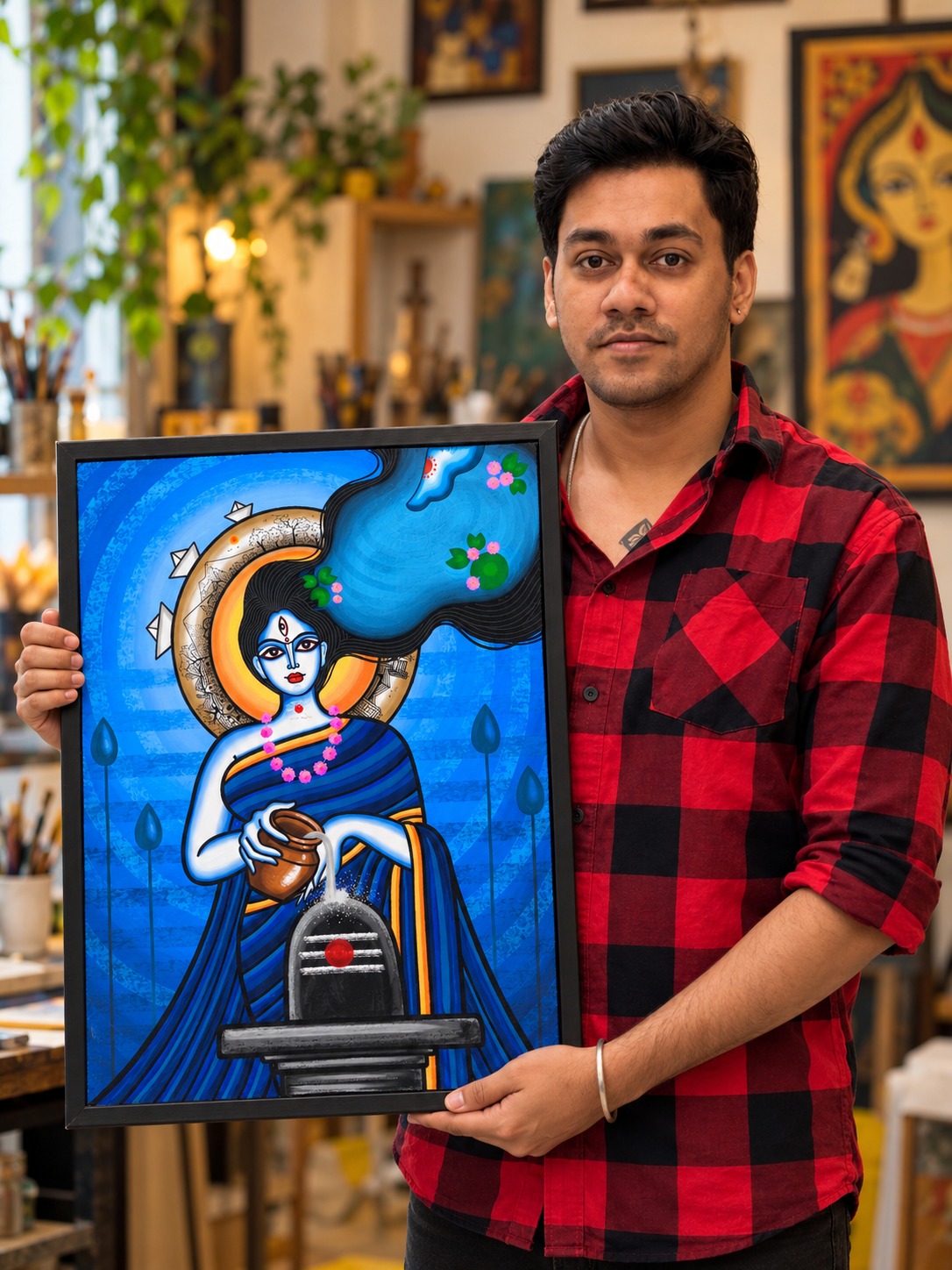
Kolkata, West Bengal | Art and Culture: In an artistic journey shaped by childhood imagination, cultural heritage and experimentation, Suvrangsu Chakraborty, popularly known as Artist Kaanha, has developed Krishnangik—an art style that brings together the visual language of Japanese anime, the bold simplicity of Jamini Roy and the storytelling traditions of Indian Patachitra.
The journey behind Krishnangik reflects an attempt to bring together seemingly different artistic worlds: the expressive characters of Japanese animation, the distinctive lines and stylised figures of modern Indian folk-inspired art, and the narrative richness of Bengal’s traditional scroll paintings.
A childhood fascination that became an artistic identity
For Kaanha, the foundations of Krishnangik began in childhood. Fascinated by the visual appeal of Japanese anime and drawn towards the colours, forms and storytelling traditions of Indian art, he gradually began exploring ways to combine these influences into a visual language of his own.
Japanese anime offered inspiration through expressive eyes, emotionally engaging characters and stylised proportions. The works of Jamini Roy introduced another dimension: bold outlines, simplified forms, striking colours and a distinctly Indian visual sensibility. Meanwhile, Patachitra provided a connection to Bengal’s indigenous artistic traditions, where figures, symbols, colours and narratives work together to tell stories.
Rather than treating these influences as separate sources of inspiration, Kaanha sought to bring them together through experimentation. Over time, this exploration developed into the foundation of what he calls Krishnangik.
What makes Krishnangik distinctive?
Krishnangik can be understood as a fusion-oriented artistic approach that combines contemporary character aesthetics with the visual vocabulary of Indian folk art.
Its central idea is to explore how the expressive energy of anime can coexist with the traditional visual identity of Bengal. The resulting approach seeks to balance modern appeal with folk-inspired design, making the artwork accessible to audiences familiar with contemporary illustration while retaining a connection to Indian artistic heritage.
The influence of Japanese anime can be seen in the emphasis on character expression and stylisation. Jamini Roy’s artistic language provides a reference point for strong contours and simplified forms, while Patachitra contributes a narrative sensibility rooted in Indian visual culture.
However, the significance of such a fusion lies not merely in combining three influences. It lies in how the artist interprets them, adapts their visual principles and develops a consistent personal vocabulary.
From private experimentation to public recognition
According to the artist’s account of his journey, Krishnangik began taking a more formal public shape in 2016. That year marked an important transition from a childhood-developed artistic sensibility towards presenting the style publicly and building an identity around it.
From 2016 onwards, Kaanha continued developing and sharing his artistic work, allowing the style to reach audiences beyond his immediate creative environment. Digital platforms and social media have created opportunities for artists to showcase distinctive visual approaches, connect directly with viewers and introduce regional influences to wider audiences.
The artist describes the subsequent growth of Krishnangik as a viral journey, reflecting the increasing visibility he associates with sharing his work publicly. Independent audience statistics and dated publication records would be needed to establish the precise scale and timeline of that reach.
Nevertheless, the development of the style represents an important personal milestone: an idea nurtured from childhood becoming an identifiable part of an artist’s public creative identity.
Connecting Japanese pop culture with Bengal’s artistic heritage
The cultural relevance of Krishnangik lies in its attempt to bridge two different visual environments. Japanese anime has developed a substantial international audience, while Indian Patachitra carries generations of storytelling, craftsmanship and regional identity. Jamini Roy, meanwhile, demonstrated how folk traditions could inform a distinctive modern artistic language.
Kaanha’s approach brings these references into conversation through an individual creative practice. It explores the possibility that contemporary influences need not displace traditional art forms; they can instead become starting points for reinterpretation.
This approach also raises an important question for contemporary Indian art: how can younger artists engage with global popular culture without losing their connection to indigenous traditions?
For Kaanha, Krishnangik offers one personal response—a visual direction that draws on childhood fascination, Indian artistic references and a desire to create something recognisably his own.
An evolving artistic journey
Suvrangsu Chakraborty, aka Artist Kaanha, continues to associate Krishnangik with the creative journey that began in childhood and entered the public sphere in 2016. Its identity rests on the intersection of expressive character design, bold folk-inspired forms and Indian narrative traditions.
Whether encountered as an experiment in cultural fusion or as the development of an individual artistic signature, Krishnangik represents Kaanha’s effort to establish a personal place within contemporary Indian visual expression.
The story is ultimately about more than combining anime with folk art. It is about how years of observation, experimentation and personal inspiration can evolve into a creative identity—one that seeks to connect the imagination of childhood with the artistic possibilities of the present.